
We care about your privacy
We use cookies that are strictly necessary in order for this website to function properly, in addition to cookies relating to the improvement and customisation of this website's experience in order to carry out statistical analysis and to provide you with advertisements based on your interests. You can accept or reject all non-necessary cookies by clicking on the respective "Accept all" or "Reject" button or, alternatively, configure them according to your preferences by clicking on the "Settings" button. For more information, please visit our Cookies Policy.
A cookie is a file that is downloaded to your computer when you access certain websites. Among other things, cookies allow a website to store and retrieve information about your browsing habits or your device and, depending on the information it contains and the way you use your computer, may be used to recognise you.
Cookies are essential for the operation of the Internet, providing countless benefits for the provision of interactive services, and facilitating the navigation and usability of our website.
The information that we provide below will help you understand the different types of cookies:
TYPES OF COOKIES
DEPENDING ON THE ENTITY IN CHARGE
DEPENDING ON THE TIME ENABLED
DEPENDING ON THEIR PURPOSE
Necessary cookies
Necessary cookies help make a website usable, activating basic functions such as page browsing and accessing secure areas of the website. The website cannot function adequately without these cookies.
Preference
Preference cookies allow more advanced functionality and a more personalised experience of our website. For example, they inform us of the pages that you have visited in order to access what you are looking for more easily.
Analytics
Analytics cookies help website owners understand how visitors interact with the website by gathering and giving information anonymously.
Marketing
Marketing cookies are used to track visitors on a website. The reason for this is to show relevant and attractive advertising for the individual user, and as such, making it more valuable for editors and third-party advertisers.
According to the provisions of Article 22.2 of Law 34/2002, of 11 July, on Information Society Services and Electronic Commerce, ALMIJARA DEL SUR S.L. would like to inform users about the cookies used on our website:
TYPES OF COOKIES
First-party cookies: YES
Third-party cookies: YES
Session cookies: YES
Persistent cookies: YES
PURPOSE
Technical cookies: YES
Personalisation cookies: YES
Analytic cookies: YES
Advertising cookies: YES
Behavioural advertising cookies: YES
Google Analytics: This service stores cookies for the statistical analysis of traffic and number of visits to this website. By accepting analytics cookies, you are giving your consent for Google to process information about you. Therefore, to exercise any right in this regard, you must communicate directly with Google.
In the case of cookies from Google Analytics, the company stores cookies on servers in the United States and agrees not to share data with third parties, except where necessary for purposes of system functionality or when required by law to this end. Google certifies that it does not store your IP address.
Google Inc. is a company that adheres to the Privacy Shield Framework, which ensures that all data transferred shall be processed with a level of protection in accordance with European regulations. You can find detailed information about this subject on the following link: https://support.google.com/analytics/answer/6004245?hl=en
If you wish, you may use the Google Analytics Opt-Out Browser Add-on, and through its settings, analytic cookies for this service may be rejected in all browsers. You can find more information about this at the following link: https://tools.google.com/dlpage/gaoptout?hl=en-GB
Likewise, COMPANY NAME hereby informs the user that they may configure their browser to alert them when cookies are received, and they may, if desired, prevent them from being installed on their hard drive.
Below are the links for different browsers in order to carry out this configuration:
Firefox: https://support.mozilla.org/en/products/firefox/protect-your-privacy/cookies
Chrome: https://support.google.com/chrome/
Internet Explorer: https://support.microsoft.com/en-GB
Edge: https://support.microsoft.com/en-GB
Safari: https://support.apple.com/en-gb/guide/safari/welcome/mac
Opera: https://help.opera.com/en/latest/web-preferences/#cookies
If there’s one day of the year when Nerja swaps swimsuits for flamenco dresses and ox-drawn carts take over the streets, it’s the 15th of May. But have you ever wondered why a town famous for the “Balcón de Europa” and its beautiful coves celebrates a patron saint of farmers with one of its biggest festivals?
Today, we’re sharing the story behind one of our favourite local traditions.
Although Nerja is a coastal town in the Axarquía region, unlike many nearby towns that have always looked towards the sea, Nerja also grew up connected to the land. Thanks to “La Vega de Nerja” (Nerja valley), the fertile plain stretching down to the coast, and the area’s abundance of water, agriculture was the town’s main source of wealth for centuries. While fishing drove the economy in other places, here it was sugar cane and local crops that shaped everyday life.
In fact, historical studies about the Axarquía region and documents from Nerja Town Hall show that, by the mid-20th century, fishing played only a small role compared to the importance of agriculture. That’s why San Isidro, the patron saint of farmers, became such an important figure for local people. In many ways, this celebration is Nerja’s yearly tribute to the land that fed generations long before tourism arrived.
Thanks to local historical research, we know that this romería (traditional countryside pilgrimage and celebration) is actually younger than many people think. It all began in 1963.
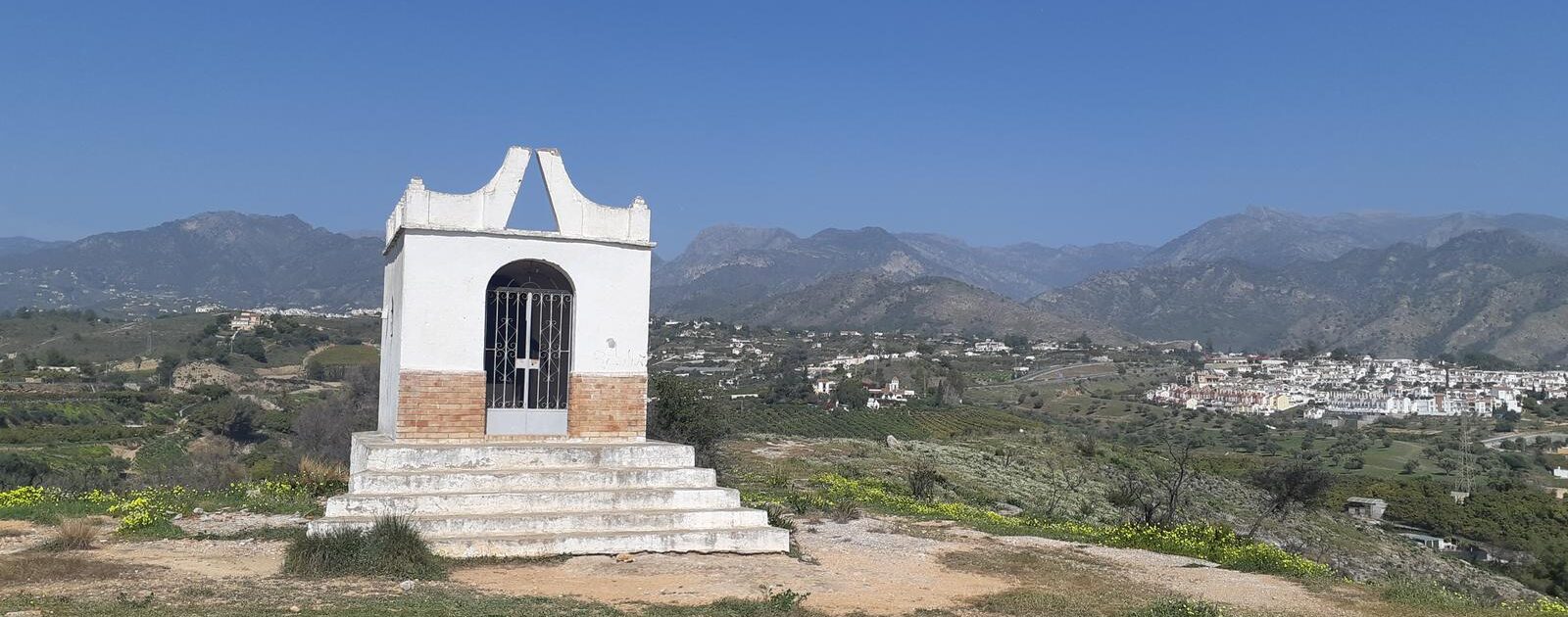
Back then, the destination was very different from the one we know today. The “romeros” (pilgrims) would take the saint up to Cerro de los Cancharrales, an area in the western part of Nerja near El Playazo beach, where the first chapel stood. It wasn’t until 1984 that the celebration moved to the area around the Cueva de Nerja. The old cemetery in Maro was transformed into the chapel visitors see today, giving the festival much more space to grow into the event it has become.
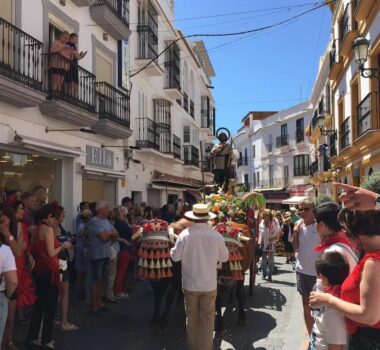
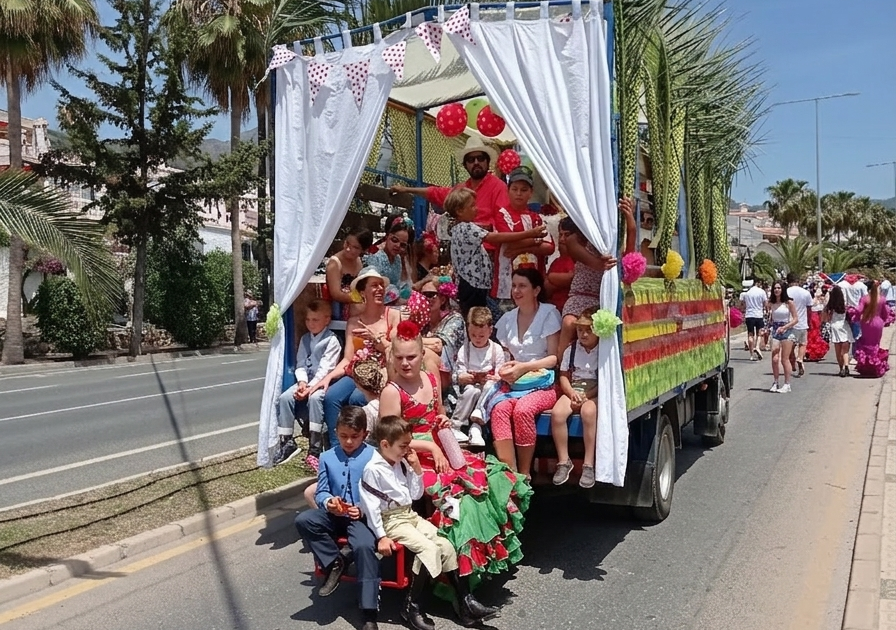
The day starts early at El Salvador Church, right beside the famous Balcón de Europa. After a morning mass, the statue of San Isidro is placed on an ox-drawn cart and the camino (the pilgrimage route) begins.
It’s around five kilometres of pure celebration. It’s not just about walking; it’s about seeing the flower-covered carts, hearing guitars playing, watching groups of friends dancing “sevillanas” and, above all, enjoying time together It’s a day for family, friends and community.. Once everyone reaches the cave grounds, the celebration turns into a huge outdoor gathering filled with traditional food and drink: Spanish omelette, serrano ham, rebujito (a popular Andalusian wine cocktail) and, of course, local wine.
Today, celebrating San Isidro in the surroundings of the Cueva de Nerja, surrounded by pine trees and one of Andalusia’s most impressive natural landmarkfeels truly special. It’s the perfect moment to experience the connection between Nerja’s prehistoric past, its agricultural roots and its present as a welcoming destination on the Costa del Sol.
Related articles
Categories