Easter Week in Nerja: tradition and evolution in the heart of the Axarquía
Easter Week in Nerja has become one of the most genuine and lively events in Málaga province’s cultural calendar. It may be smaller and less crowded than the big cities, but it’s just as meaningful. Here, tradition and devotion sit side by side with the sea air and the scent of orange blossom.
In recent years, the celebration has evolved. There’s better coordination between the hermandades (religious fellowships), stronger support from local institutions, and, importantly, a new generation getting involved, helping to keep these traditions alive. At the same time, older customs have been brought back, such as the Pasos de la Puebla de Nerja, which had almost disappeared and are now part of the town’s heritage again.
Today, three main groups shape Holy Week in Nerja: Cofradía del Nazareno, Cofradía del Resucitado, and the Grupo Parroquial del Cautivo. But what really makes Nerja stand out?
From the small “Tronillos” carried by children to the processions passing through the Balcón de Europa, each day offers something different. It’s something best experienced in the streets, up close.
These days, Holy Week in Nerja is a mix of long-standing tradition, revived customs, and fresh energy from younger generations. If you want to know and explore the routes, key moments, and what makes each procession special, keep reading—we’ll guide you through it.
Schedule and Routes of the Easter Week Processions in Nerja 2026
| Saturday March 28, 2026 |
The “Tronillos” |
|---|---|
| Approx. departure time: ~5:00-5:30 pm. Usual route: Generally, begins near Plaza de España and ends at El Salvador Church. |
|
| Palm Sunday March 29, 2026 |
Approx. time: 11:30 am. Route: Departure from La Ermita, passing along Calle Angustias, Calle Pintada and Calle Puerta del Mar, then along Paseo Balcón de Europa, arriving at El Salvador Church. |
| Holy Monday March 30, 2026 |
Pasos de la Puebla de Nerja |
| Time: 5:30 pm. Location: Balcón de Europa. |
|
| Holy Wednesday April 1, 2026 |
Nuestro Padre Jesús Cautivo y María Santísima de los Desamparados |
| Approx. departure time: 7:00 pm. Departure point: El Salvador Church. Route via Paseo Balcón de Europa, Calle Puerta del Mar, Calle Pintada, Calle Cervantes, Calle Bronce, Calle América, Calle San Miguel, Plaza de la Ermita, Calle Granada, Plaza Cavana, Calle Carmen and Paseo Balcón de Europa, returning to El Salvador Church. |
|
| Maundy Thursday April 2, 2026 |
Jesús Nazareno y María Santísima de la Esperanza |
| Approx. departure time.: 8:00 pm. Route: From the Throne Hall of the Brotherhood House, along Calle Puente Viejo, Calle Carretera, Plaza de la Ermita, Calle Granada, Plaza Cavana, Calle Carmen, Paseo Balcón de Europa, Calle Puerta del Mar, Calle Pintada, Plaza Cantarero, Calle Méndez Núñez, Calle Bronce, Calle Angustias, Plaza de la Ermita, Calle San Isidro, Calle Ingenio and Calle Puente Viejo, returning to the “Casa Hermandad” (Brotherhood House). |
|
| Good Friday April 3, 2026 |
Santo Entierro y María Santísima de los Dolores |
| Approx. departure time: 8:00 pm. Route: From the Throne Hall of the Brotherhood House, along Calle Puente Viejo, Calle Carretera, Plaza de la Ermita, Calle Granada, Plaza Cavana, Calle Carmen, Paseo Balcón de Europa, Calle Puerta del Mar, Calle Pintada, Plaza Cantarero, Calle Méndez Núñez, Calle Bronce, Calle Angustias, Plaza de la Ermita, Calle San Isidro, Calle Ingenio and Calle Puente Viejo, returning to the “Casa Hermandad”. |
|
| Easter Sunday April 5, 2026 |
Jesús Resucitado, María Santísima de la Asunción y la Santa Cruz Gloriosa |
| Approx. departure time: 12:00 pm. Route: Paseo Balcón de Europa, Calle Puerta del Mar, Calle Pintada, Calle Arropieros, Calle Los Huertos, Calle Frigiliana, Calle Carretas, Calle Alfonso XII, Calle Bronce, Calle Nueva, Calle Pintada and Paseo Balcón de Europa, returning to El Salvador Church. |
Everything you need to know
- Boletín Informativo Anual “Cofradía del Nazareno” 2026.pdf (Spanish) (high quality | low quality)
- Penitente – Cofradía del Resucitado 2026 (Spanish)
- “Cofradía del Nazareno” of Nerja (Facebook | Instagram)
- “Cofradía del Resucitado” of Nerja (Facebook | Instagram)
- “Grupo Parroquial Cautivo y Desamparados” of Nerja (Facebook | Instagram)
Cofradía del Nazareno (Fellowship of the Nazarene)
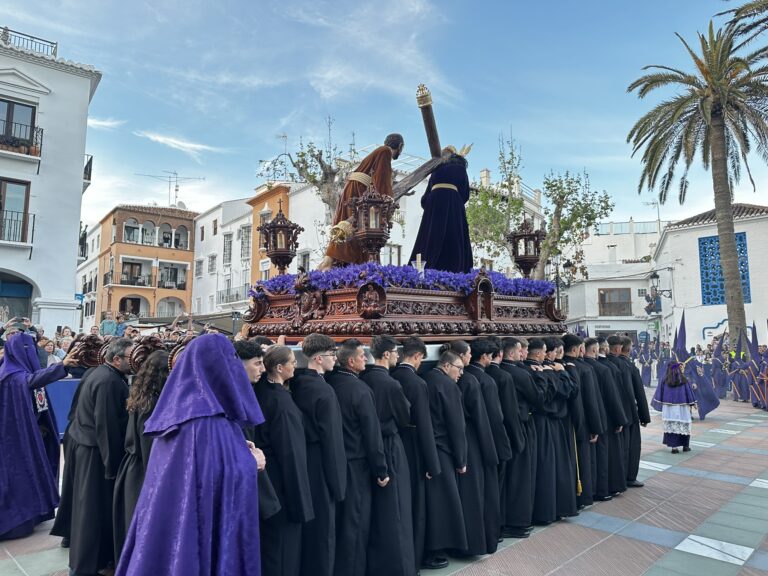
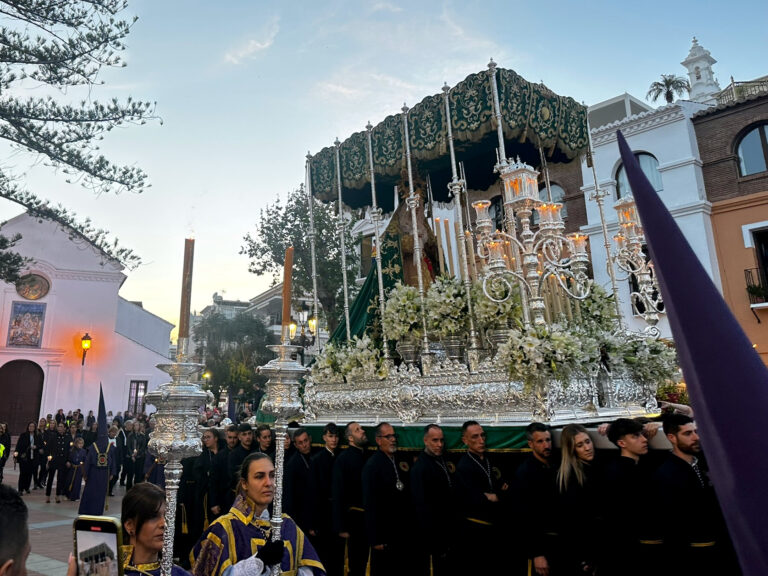
The Cofradía del Nazareno —full name: Ilustre y Venerable Cofradía de Nuestro Padre Jesús Nazareno, María Santísima de los Dolores, Santo Entierro y María Santísima de la Esperanza— is the oldest and most established Fellowship in Nerja, and a key part of its Holy Week.
For a long time, it was thought to date back to the late 18th century. However, recent historical research has uncovered documents from 1735 and 1736 suggesting it already existed much earlier. One example is a will in which a local man asked to be buried wearing the brotherhood’s tunic. These findings show that the fellowship was already well organised and widely followed decades before 1792, which is likely when the separate brotherhood of the Virgin of Sorrows (Virgen de los Dolores) was founded. The two later merged into the current organisation.
In terms of processions, the Fellowship is central to some of the most important days of the week. On Maundy Thursday, Jesús Nazareno takes to the streets alongside the Virgin of Hope (Virgen de la Esperanza). Then on Good Friday, the same Fellowship leads the Holy Burial (Santo Entierro) and the Virgin of Sorrows.
A small historical note: the current statue of Jesús Nazareno dates from 1944 and was created by sculptor Domingo Sánchez Mesa, replacing an earlier figure lost during the Spanish Civil War. Much of the parish archive was also destroyed at that time, which makes the surviving documents especially valuable for understanding the town’s history.
Cofradía del Resucitado (Fellowship of the Risen Christ)
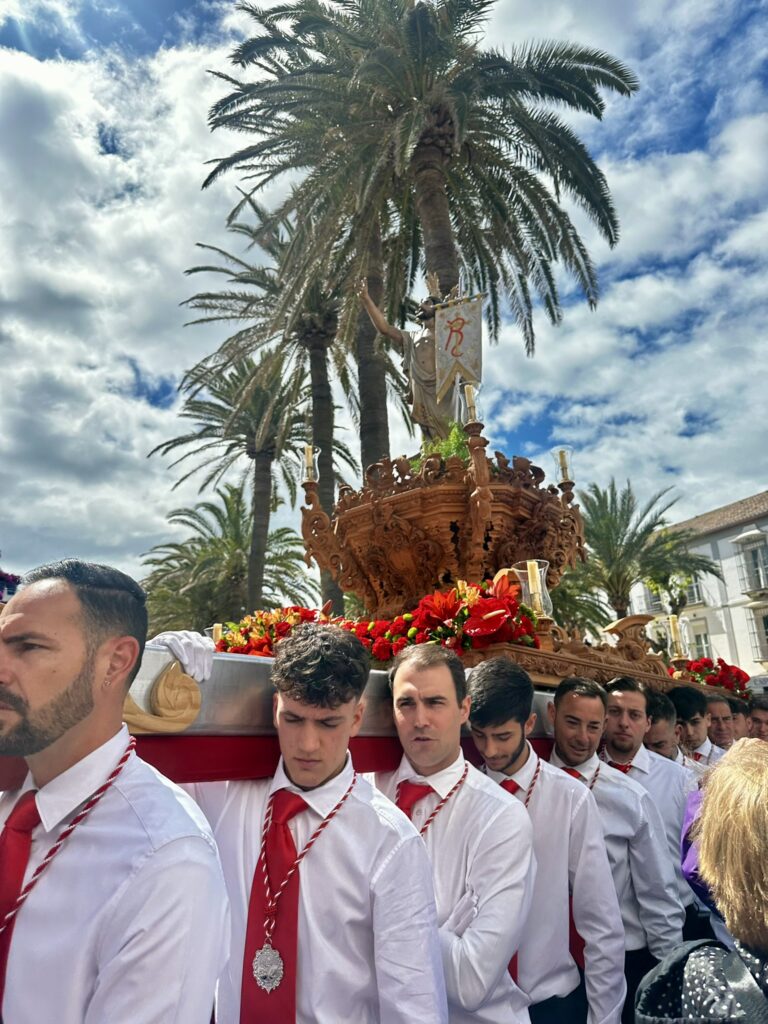
The Cofradía del Resucitado — The Fellowship of the Risen Christ— brings Holy Week in Nerja to a close each Easter Sunday, shifting the mood from mourning to celebration.
Unlike the quieter, more solemn days before, this procession is bright and festive. Participants wear white robes with red and white hoods, and the atmosphere is much more open and joyful. Instead of silence, you’ll hear cheering, see petals thrown from balconies, and notice whole families taking part.
One of the highlights is the meeting between the Risen Christ and the Virgin of the Assumption (Virgen de la Asunción) at the Balcón de Europa. It’s a symbolic moment that marks not just the end of Holy Week, but also the start of spring in the town.
🔎 Interesting fact
The Glorious Holy Cross is a very special throne within this procession, as it is carried exclusively by women, a tradition that has been maintained for many years and that provides an added symbolic value, reinforcing the participatory and representative character of the Fellowship in the Nerja society.
Grupo Parroquial del Cautivo (Parish Group of the Captive Christ)
The Grupo Parroquial del Cautivo y María Santísima de los Desamparados is a good example of how Nerja’s traditions continue to evolve.
Founded in 1997, it actually grew out of what locals used to call the “children’s procession”. Over time, that small, informal event developed into a fully established procession of its own, now held every Holy Wednesday.
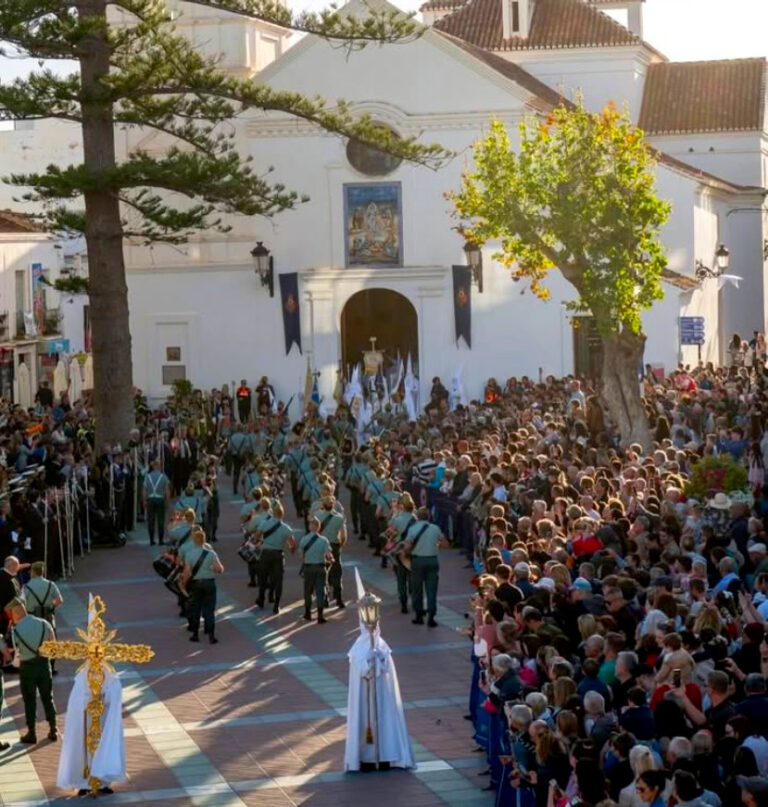
What started as something simple has become a well-organised and important part of the official programme. A key moment in its development was the inclusion of a group of former Spanish Legion members from Torremolinos, which added a more formal and striking element to the procession and helped draw larger crowds.
The group is also known for its social commitment. One meaningful detail is that the candles carried with the Virgin include the names of women who were victims of gender-based violence. Overall, it’s a fellowship that shows how newer generations are shaping and strengthening the tradition.
The "Pasos de la Puebla": a tradition brought back after 175 years
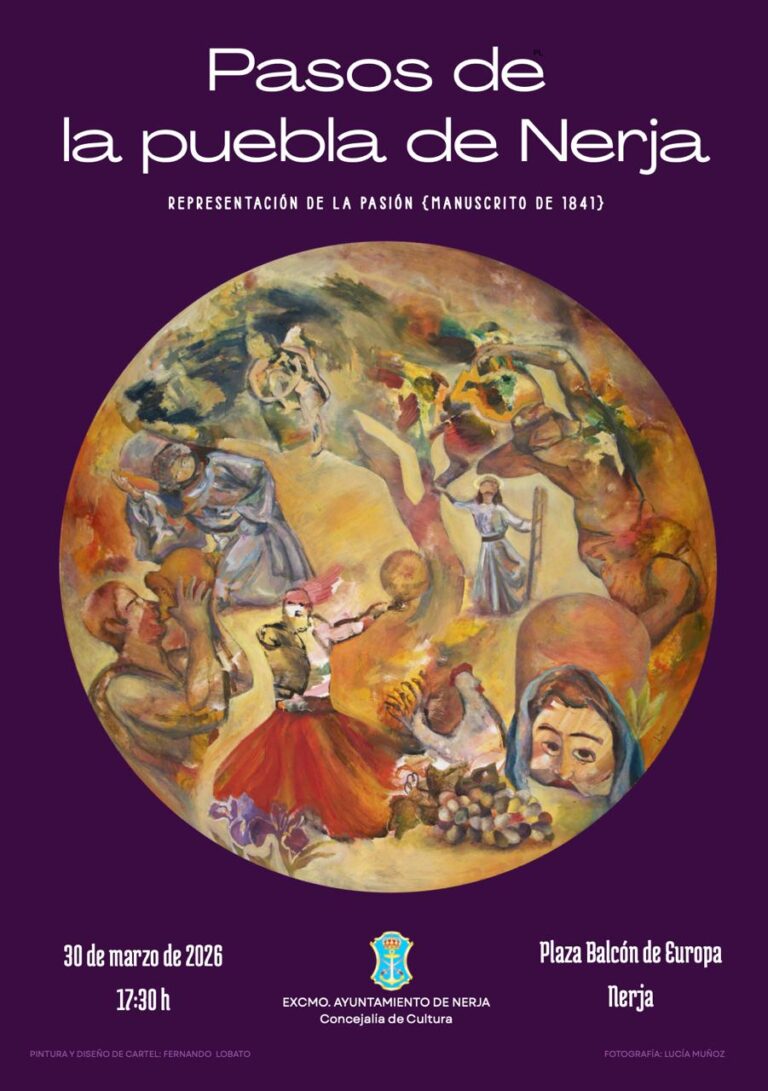
One of the most unique additions to Holy Week in Nerja in recent years is the return of the Pasos de la Puebla, a tradition that had disappeared for over 150 years.
Rather than a standard procession, this is a theatrical performance based on a manuscript from 1841. It tells different parts of the Passion of Christ and was originally performed in Nerja until around 1850. The text was written by priest Antonio Peláez García and has been brought back to life thanks to research by historian Francisco Capilla.
Today, it’s staged in open spaces such as the Balcón de Europa and combines theatre, music and local tradition. Local actors, musicians and community groups take part, creating a carefully produced performance that gives a sense of what the town’s Holy Week might have looked like in the 19th century.
“Los Tronillos” Procession
On Saturday, Nerja hosts one of its most distinctive events: the procesión de los tronillos.
This is a procession led entirely by children, who recreate the main elements of the adult processions on a smaller scale—from carrying the tronos (floats) to following the same slow, steady rhythm.
Beyond being charming to watch, it also plays an important role locally. It’s seen as a kind of training ground where children learn the traditions and take part from a young age, often going on to join the main brotherhoods later in life.
Usually centred around the Balcón de Europa, it’s a popular event with visitors and a clear example of how these traditions are passed down from one generation to the next.